Hume Band 2.0 offers up to 14 days of battery life with included core app tracking and no required subscription. This fitness tracker battery life comparison covers published runtimes, different operating modes, and charging habits that help you keep tracking sleep and activity.
- Hume Band 2.0 lists up to 14 days of battery life with included core app tracking.
- Manufacturer battery claims use different conditions, not a shared cross-brand test.
- Compare everyday runtime separately from GPS recording and battery-saving modes.
- Plan charging around overnight wear if sleep trends are your priority.
Keep charging from interrupting your tracking
The best battery is the one that keeps your tracker on your body when you need it. Missing an overnight recording because the device is charging leaves you without that night's sleep information, regardless of how many features the tracker offers.
For your 2026 shortlist, separate maximum advertised endurance from runtime with the features you actually use. A smartwatch-mode rating does not describe continuous GPS recording, and an always-on display changes the comparison again.
The rankings below cover selected models with published manufacturer specifications. They are not a claim that these are the newest devices or the longest-lasting products across the entire market in 2026.
What makes the best fitness tracker for battery life?
- Comparable operating mode: Compare smartwatch or everyday tracking figures first. Keep GPS and battery-saving modes separate.
- Useful tracking between charges: Decide whether sleep, activity, or recorded outdoor workouts matter most to you.
- Wearable size: A large endurance watch and a slim fitness band solve different problems, even when both record activity.
- Charging routine: Choose a device you can recharge without repeatedly missing the information you want.
- Included tracking: Check which insights remain accessible without optional paid services. Battery endurance does not explain the app's ongoing requirements.
Do not trade away your main tracking feature just to reach the longest advertised runtime. If sleep is your priority, a charging plan that preserves overnight wear matters more than a maximum figure measured under different settings.
Fitness tracker battery life comparison at a glance
The figures below are manufacturer-rated maximums, not measured results from a shared test. Hume Band 2.0 appears first as the featured product, followed by selected watches and bands. The row order is not a numerical endurance ranking.
| Device | Published battery life | Device format |
|---|---|---|
| Hume Band 2.0 | Up to 14 days | Health-tracking band |
| Garmin Enduro 3 | Up to 36 days in smartwatch mode, without solar contribution | Outdoor sports watch |
| Garmin Instinct 2 Solar | Up to 28 days in smartwatch mode, without solar contribution | Outdoor watch with solar charging capability |
| Fitbit Inspire 3 | Up to 10 days | Compact fitness band |
| Fitbit Charge 6 | Up to 7 days | Fitness band with built-in GPS |
| Apple Watch Series 10 | Up to 18 hours of normal use | iPhone-connected smartwatch |
Source scope for this 2026 comparison: Hume Band 2.0's current product page, Garmin's Enduro 3 and Instinct 2 Solar specifications, Google's Fitbit Inspire 3 and Charge 6 battery documentation, and Apple's Watch Series 10 technical specifications. Each manufacturer defines its own usage conditions; these figures do not constitute a standardized cross-brand test.
Hume Band 2.0: everyday tracking between charges
Hume Band 2.0's current product page lists up to 14 days of battery life. That advertised maximum is not a guarantee for every setting or routine. Follow the device's charging instructions and check how often you need to recharge during your own daily use.
Hume Band 2.0 highlights
- Up to 14 days of advertised battery life.
- Sleep, activity, strain, and recovery insights in the companion app.
- Included core app tracking without a required subscription.
- Works on its own; Hume Pod 2.0 is optional.
Best for: Everyday adults who want multiday wearable tracking with included core app access.
Premium coaching and deeper personalized analysis are optional paid upgrades. The band is a consumer health tracker, not a diagnostic device or replacement for medical care.
Garmin Enduro 3: smartwatch-mode battery specification
Garmin lists up to 36 days in smartwatch mode without solar contribution for Enduro 3. This is an outdoor sports watch, with separate ratings for GPS recording. Solar-assisted figures depend on the manufacturer's stated exposure conditions. The runtime figure does not establish tracking accuracy or overall product quality.
Garmin Instinct 2 Solar: baseline and solar-assisted use
Garmin Instinct 2 Solar lists up to 28 days in smartwatch mode before solar contribution. Its solar charging capability depends on light exposure, which varies with surroundings, clothing, season, and time outdoors. An everyday rating does not describe continuous GPS recording or guarantee independence from a charger.
Fitbit Inspire 3: compact fitness-band format
Fitbit Inspire 3 lists up to 10 days of battery life and records everyday activity and sleep. It does not have built-in GPS. Display settings and usage affect runtime, so the maximum claim should not be treated as a personal guarantee.
Fitbit Charge 6: GPS and daily tracking
Fitbit Charge 6 lists up to 7 days of battery life and includes built-in GPS. GPS recording uses more power than ordinary daily tracking. Check the separate recording conditions rather than applying the everyday rating to a continuous workout.
Apple Watch Series 10: normal-use battery rating
Apple Watch Series 10 lists up to 18 hours of normal use under Apple's test conditions. It requires a compatible iPhone. If you use it overnight, plan charging separately from your sleep-recording window.
Use the tracking you keep collecting
Hume Band 2.0 brings sleep, activity, strain, and recovery insights into the Hume Health app. Use those trends to ask practical questions: Are your sleep patterns changing? Does your activity look different on workdays?
If you also use Hume Pod 2.0, the app brings body-composition and wearable insights together. The Pod is optional and is not needed to use the band.
Match the battery claim to your routine
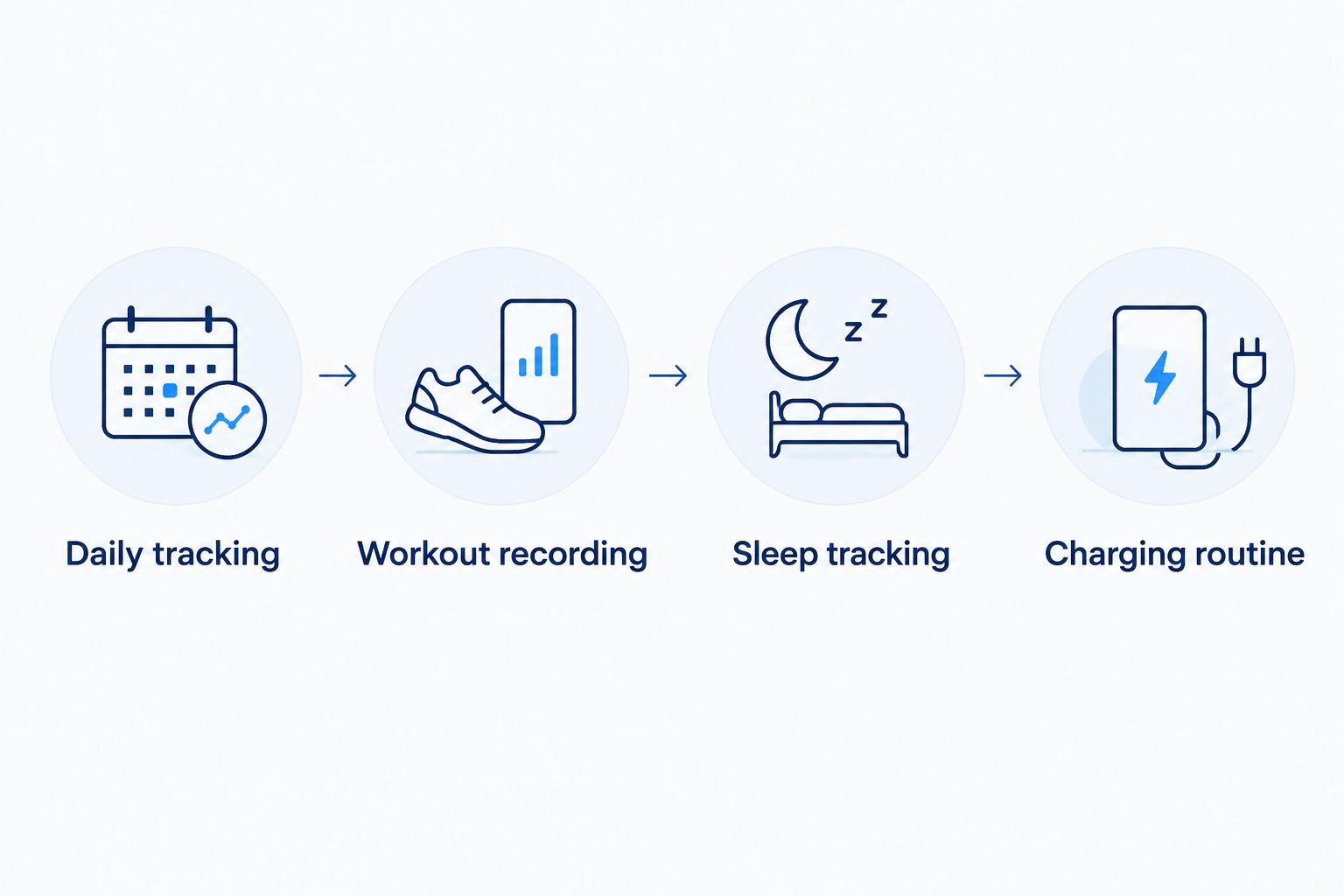
Use this sequence before choosing a tracker in 2026:
- Daily tracking: Start with the normal-use or smartwatch-mode rating. Exclude special battery-saving figures from the first comparison.
- Workout recording: Check the separate GPS rating if you record outdoor routes. Do not substitute everyday endurance for workout endurance.
- Sleep tracking: Identify a charging opportunity that does not repeatedly overlap with bedtime.
- Charging routine: Decide whether the device fits your actual habits, including travel and access to its charger.
A useful personal check is to note your settings and charging pattern during ordinary use. Keep workout recording, display settings, and overnight wear consistent before deciding whether the battery meets your needs.
How the ranking works
This 2026 comparison presents published maximum runtimes for selected models, with Hume Band 2.0 featured first. It is not a shared battery test or a numerical leaderboard. Solar-enhanced estimates, low-power modes, and continuous GPS figures describe different operating conditions.
The recommendations then apply the earlier criteria: size, outdoor recording, overnight wear, and included tracking. No single endurance number proves better measurement accuracy, better recovery guidance, or better health outcomes.
Which fitness tracker should you choose?
Choose Hume Band 2.0 for everyday sleep, activity, strain, and recovery tracking with up to 14 days of advertised battery life and included core app access. Premium coaching and deeper personalized analysis are optional paid upgrades.
Plan charging around the information you want to keep collecting. A maximum runtime is useful context, but your settings and daily routine determine how often you recharge.
FAQ
How long does Hume Band 2.0's battery last?
Hume Band 2.0's current product page lists up to 14 days of battery life. Treat that as an advertised maximum, not a guarantee for every setting or routine.
Are manufacturer battery ratings directly comparable?
Not as a shared test. Manufacturers use different operating modes and test conditions, so compare normal use, GPS recording, and low-power settings separately.
Does GPS use reduce fitness tracker battery life?
Yes, GPS recording uses more power than ordinary everyday tracking. Compare the manufacturer's GPS-mode specification separately from its normal-use rating.
Is solar charging enough to stop charging a fitness watch?
Solar charging is not a general guarantee that you can stop using a charger. Its contribution depends on the device's stated exposure conditions and your actual use.
Can I use Hume Band 2.0 without Hume Pod 2.0?
Yes, Hume Band 2.0 works on its own. Hume Pod 2.0 is optional for readers who also want an at-home body-composition analyzer.
Does Hume Band 2.0 require a subscription for core tracking?
No, core tracking in the companion app does not require a subscription. Premium coaching and deeper personalized analysis are optional paid upgrades.
Should I choose a tracker based only on battery life?
No, choose a tracker that records the information you need and fits your charging routine. Size, GPS requirements, phone compatibility, and included app tracking also affect the decision.
One last thing
A longer battery claim is not a measurement-quality score. Before your first overnight recording, decide when you will charge the device; protecting the data you actually want is more useful than chasing a maximum runtime you will not use.